
However, the open-source nature of the Android platform, known for its freedom to install applications, is about to undergo a significant transformation. In particular, Google has formally announced the timeline of deployment for its long-awaited Android App Verification Service, which will serve as an entirely new element of the core system, changing the way side-loading of apps on smartphones will be performed.
Although Google presents such changes as an essential protection measure from the unprecedented global increase in malware aimed at mobile banking, the community of advanced users calls this transformation the “App-ocalypse.” It does not matter whether this transition will result in complete security or in structural limitations; this process will start this month and lead to major changes in the ecosystem from September 2026.
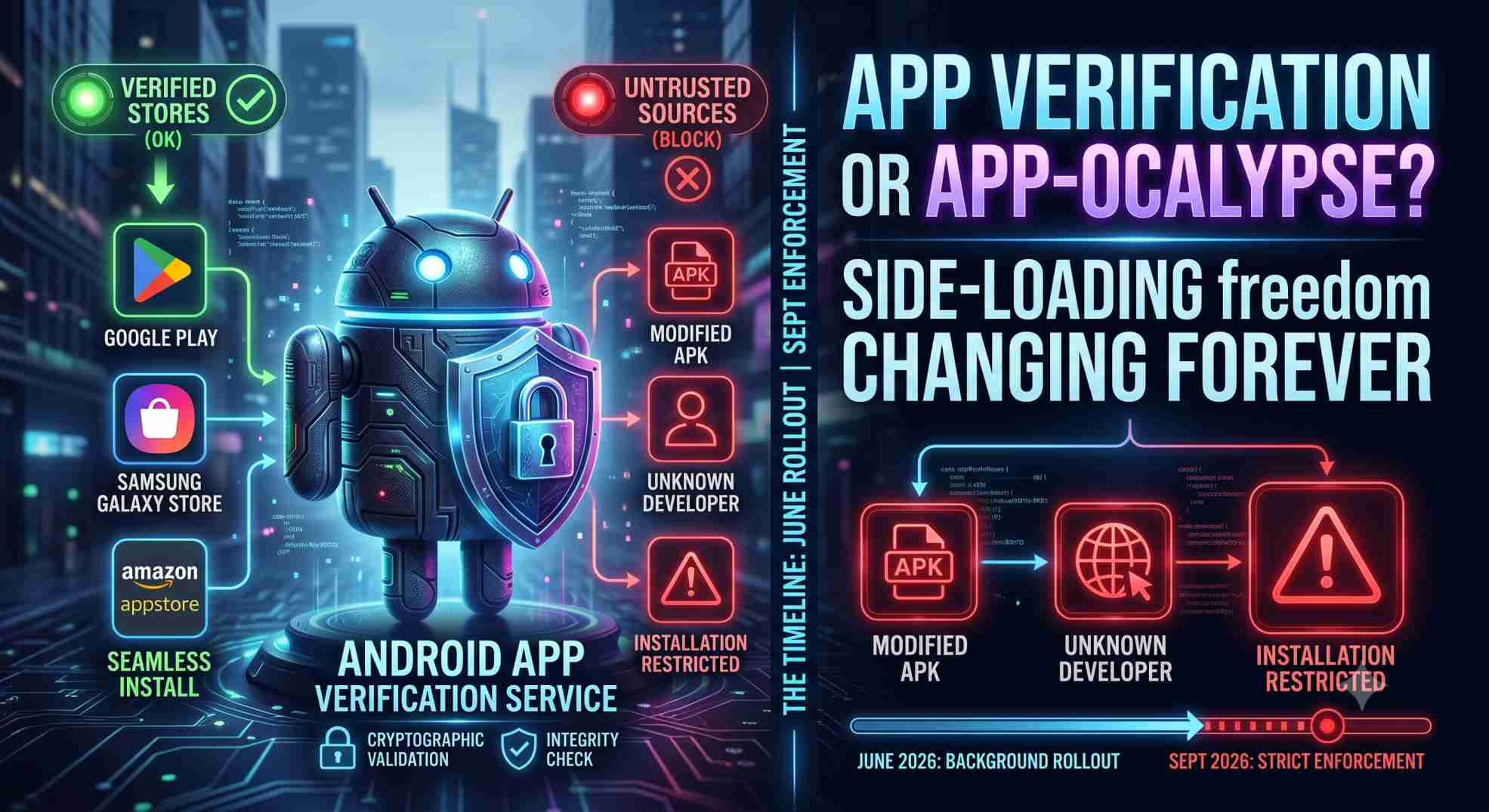
What Is the Android App Verification Service?
Android App Verification Service represents an independent and lower level infrastructure designed by Google. In contrast to Google Play Protect that represents a malware scanning application running at the software level and which can be easily turned off by users, the new structure was incorporated directly into the core structure of Android OS.
After its complete activation, the system performs the validation of cryptographic signatures on every try of a user to install an application. This procedure involves the identification of the developer of the application, verification of integrity of its code, and identification of its source.
The Enforced Timeline: June Rollout to September Enforcement
Google has clearly stated its phased strategy in implementing this framework in active devices all over the world with minimum disruptions at the beginning of the process.
- June 2026 (Background Ingestion): It is the time when Google will begin with its silent background implementation of the core system services framework. Active devices with supported versions of Android will receive the backend background framework through Google Play System Updates.
- July-August 2026 (Integration Window): Third-party app stores and certified developers should make sure that the package signing keys and APIs of distribution have been integrated with the verification systems of Google.
- September 2026 (Enforcement): The real structural changes are going to happen. All applications installed from outside any of the trusted marketplaces will face intensive security checks and warnings, or installation blockades.
How Will the New Verification System Work?
When a user downloads an APK file from a web browser or a file-sharing app and hits the install button, the background process undergoes a strict validation sequence:
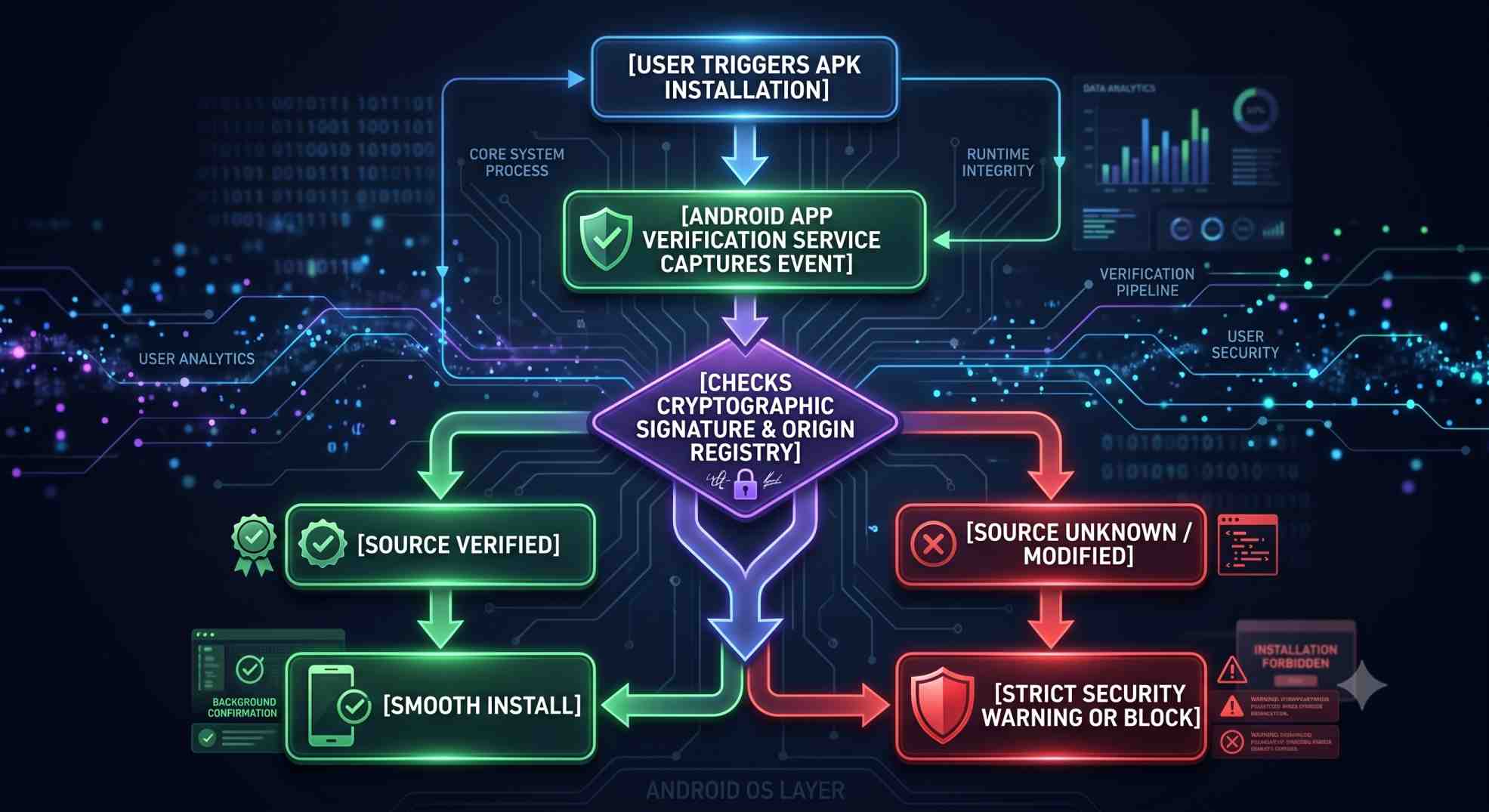
In the case where the signature is verified by the Google Trusted Network Registry, the installation goes on smoothly. However, in the event where the system verifies the tampering of package signatures, a corrupt cryptography chain or simply an untrusted distribution point, the system service prevents the installation from proceeding, showing a very strong security barrier to the user.
Supported App Stores: The “Trusted” Group
According to Google, the objective is not to eliminate the legitimate third-party app stores altogether. The aim of the company is to maintain a list of Supported App Stores that inherently adhere to Google’s stringent communication security guidelines.
Verified Ecosystem Access Matrix
| Approved App Marketplace | Official Compliance Status | Side-Loading Freedom Level |
| Google Play Store | Fully Integrated Native | Absolute (Default System Standard) |
| Samsung Galaxy Store | Officially Supported OEM | Smooth Background Installations |
| Amazon Appstore | Officially Supported Third-Party | Verified & Clear Passing |
| Xiaomi GetApps / Oppo Store | Officially Supported OEM | Smooth Background Installations |
| Independent Modding Sites | Untrusted / Blocked | High Warning Barriers / Installation Restricted |
App Verification vs App-ocalypse: What It Means for You
Based on your personal smartphone usage preferences, this update to the structural framework may represent either a great security update or just a nuisance.
The Security Side (App Verification)
To the general public, this is definitely a good thing. This prevents the execution of any malware apps, eliminates cloned financial apps, and even stops malicious websites from silently launching drive-by APK downloads that are linked with financial fraud schemes.
The Developer Backlash (The App-ocalypse)
However, to the developer community and people interested in hacking and modding their smartphones, this represents another step towards locking down the ecosystem. Popular mods (from ad-blocking video player apps, different types of streamer client mods, premium unlocked apps and independent games not available in any central app stores) will receive severe resistance.
Hidden Vulnerabilities: Why Google Is Forcing This Change
As stated in various Android Security Briefs leaked in the early months of the year, the simple software scan layers cannot be used to counter the modern day cyber attacks. The hackers make use of a procedure known as “Session Hijacking” together with package mutation where a seemingly harmless utility app that has been sideloaded runs well for some days until it downloads a malicious payload in the background. Google uses this method to prevent any runtime modifications from altering the core operations of the phone.
Conclusion: A Necessary Evil for the Modern Era
Android App Verification is a definite sign that the era of unbridled and wild west APK sideloading is definitely over. Google is more concerned about liability and user money than developer freedom.
Whereas advanced users may find the September 2026 restrictions annoying, this update is a security necessity for dealing with modern web-based exploits. As long as you install applications from well-known stores that verify their content, nothing will change in your daily smartphone use and everything will be much safer. However, those who frequently use custom apps or indie apps in separate packages, get ready for many more system pop-ups in the nearest future.
My Opinion: Is It True Security or Just an Ecosystem Lockdown?
After following the development of Android through its totally open period, this new version represents a huge leap. In this case, Google seems to be trying to toe a very fine line, between preserving users’ freedom and transforming Android into a closed ecosystem, such as iOS on Apple’s devices.
- Security Concerns in the Modern Environment: The security reality of 2026 cannot be ignored at all. Mobile banking fraud cases, as well as malicious background overlays, have evolved into extremely advanced threats. For the average user, such as parents or those who do not know much about technology, having a cryptographic system service, which stops any malicious, spoofed APKs, can be a real lifesaver.
- Sideloading and Android Fans: However, for Android fans who chose it for being an open platform, this will lead to major friction. Even though Google claims that they support other marketplaces, such as Amazon or Samsung, prohibiting or severely warning against independent modding communities, open source software like F-Droid utilities, or plain standalone APKs, seems to go too far.
Frequently Asked Questions (FAQs)
What is the new Android App Verification Service update?
It is a low-level background system service rolling out in June 2026 that cryptographically scans and verifies the source and integrity of all app installations on Android devices to block malware and unauthorized side-loading.
When will the new Android app side-loading rules take effect?
The background rollout begins globally in June 2026, while the strict enforcement phase and app store compliance checks are officially scheduled to launch in September 2026.
Will I still be able to install apps from the Samsung Galaxy Store?
Yes. Major manufacturer marketplaces like the Samsung Galaxy Store, Amazon Appstore, and official OEM portals are fully recognized by Google as verified, supported app stores.
Can I turn off the Android App Verification Service?
No. Unlike Google Play Protect, which operates as an interface-level security toggle, this new verification system is embedded deep within core system updates, meaning it cannot be uninstalled or disabled by regular user profiles.
Read Also: Android 17 Features