
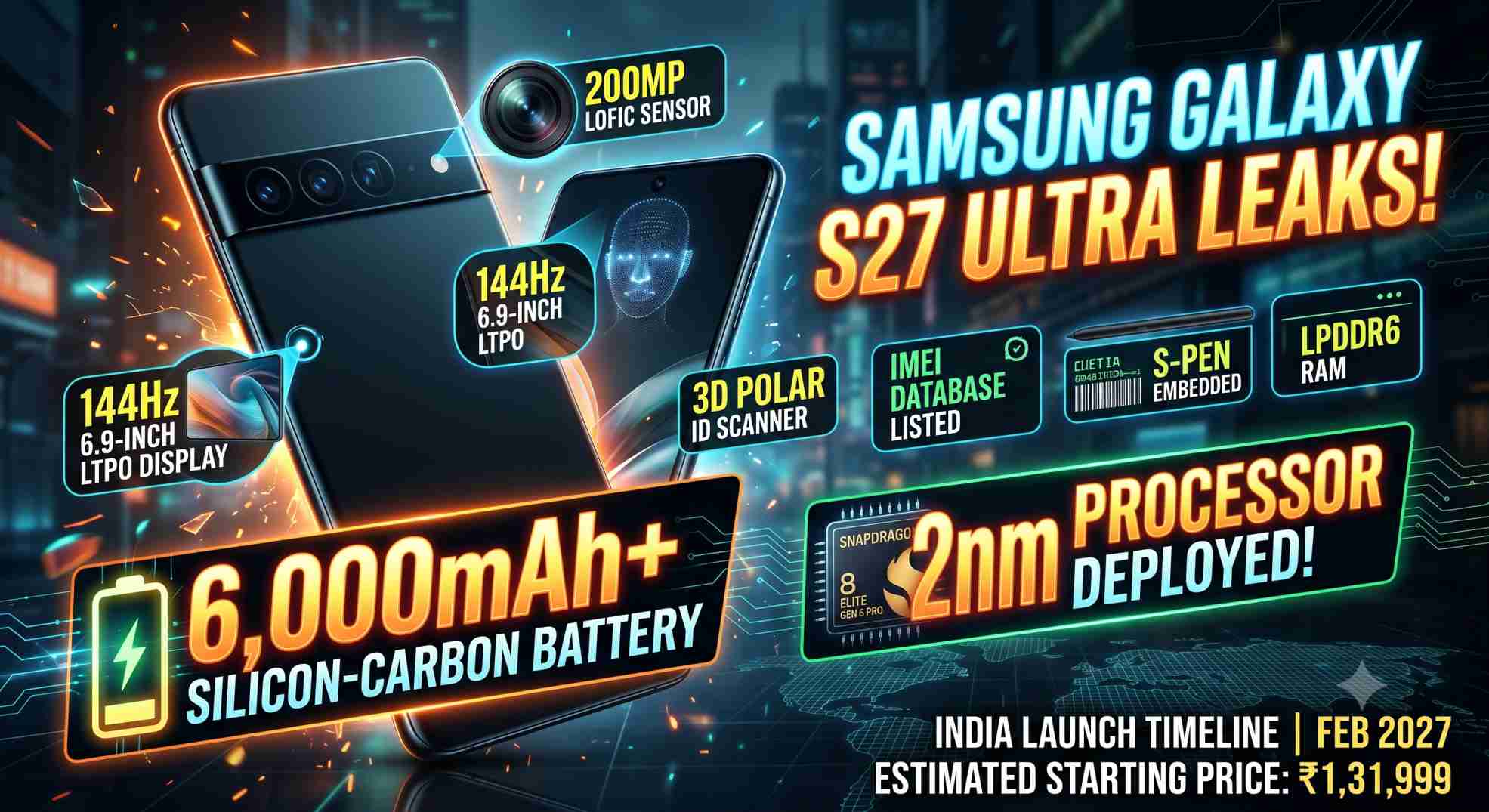
There is much excitement surrounding the smartphone ecosystem, given that preliminary leaks and database registrations have revealed massive information about Samsung’s upcoming new flagship line. The Samsung Galaxy S27 Ultra is expected to be the most revolutionary change by Samsung in years, especially with the groundbreaking 2nm Chipset deployed for extreme performance. Moving away from usual minor improvements, Samsung is completely re-engineering its product line. This structural shift is highly visible through the integration of an ultra-dense 6000mAh+ Silicon-Carbon Battery and compact 3D biometrics confirmed through various verified supply chain sources regarding the new premium flagship.
The Core Performance Engine: 2nm Chipset & LPDDR6 RAM
To gamers and power users, the gadget serves as the leaps baseline. Beneath its hood, Samsung’s official split-processor strategy involves the deployment of the company’s native Exynos 2700 for base variants but keeping the extreme silicon for the high-end version.
- Qualcomm Snapdragon 8 Elite Gen 6 Pro: This next-gen mobile system on a chip takes processing speeds and multi-core threads to extreme levels through its cutting-edge 2nm fabrication node technology while dissipating minimal heat generation.
- LPDDR6 Memory Subsystem: To ensure that mobile gaming does not suffer from data bottlenecks, the processor is paired with advanced LPDDR6 RAM, which loads assets at lightning-fast speeds.
Structural Battery Leap: 6,000mAh+ Silicon-Carbon Module
Samsung is finally tackling its 5,000mAh limitation issue. Through its innovative use of the Silicon-Carbon battery technology, Samsung engineers have been able to make major strides in increasing density within the phone’s frame.
- Benefits of Density: Contrary to the lithium-ion batteries, silicon-carbon batteries have a lot more capacity within the same physical dimensions. Therefore, the phone will be able to accommodate up to 6,000mAh – 6,500mAh power reserve without altering the thickness of the outer chassis.
- Magnetic Charging Module: It appears Samsung might finally switch to a horizontally-oriented charging loop on the backplate for its Qi2 ecosystem support.
Camera Transformation: LOFIC Sensor & Clean Tri-Cam Layout
The matrix of the rear camera system receives a debatable but very logical evolution. Samsung gets rid of the secondary 10MP 3x telephoto lens—the sensor which has not undergone any changes since the Galaxy S21 Ultra times.
The Revolutionary Triple-Lens System:
- 200MP Main Camera (ISOCELL HP6 / HPA): It consists of an enormous 1/1.12-inches architecture, where it has a mechanical Variable Aperture in order to have precise optical depth. Even more crucially, it has something called LOFIC, which is the acronym of Lateral Overflow Integration Capacitor technology.
- 50MP Ultrawide Camera: Upgraded optics for wider fields of view and sharper edge retention.
- 50MP Periscope Telephoto (5x Optical Zoom): Handles high-magnification captures effortlessly.
The 3x Zoom Alternative: Rather than relying on a separate 3x lens, Samsung will deploy a new technology called “lossless in-sensor cropping” to the 200MP module, which would create space for bigger thermal modules and batteries.
The Lineup Breakdown & Launch News
Samsung Galaxy S27 Series has already leaked through the global IMEI database, unveiling an unusual change to the standard structure of this product series. There is a special Galaxy S27 Pro which fills the gap between the basic and the enthusiast models.
Samsung Galaxy S27 Lineup Core Specifications Matrix:
| Specification Parameters | Samsung Galaxy S27 Pro (New Model) | Samsung Galaxy S27 Ultra (Flagship King) |
| Display Footprint | 6.47-inch compact LTPO AMOLED | 6.9-inch Dynamic LTPO AMOLED (144Hz) |
| Primary Chipset Array | Snapdragon 8 Elite Gen 6 / Exynos 2700 | Snapdragon 8 Elite Gen 6 Pro (2nm Node) |
| Stylus Integration | No S-Pen Compatibility | Native S-Pen Embedded Housing |
| Biometric Framework | Standard Under-Display Fingerprint | 3D Polar ID Hardware Scanning |
| Rear Camera Layout | Triple Camera Setup | 200MP LOFIC (Variable Aperture) + Dual 50MP |
| Expected Base Price | ₹99,999 (Estimated India Base) | ₹1,31,999 (Expected 12GB+256GB Base) |
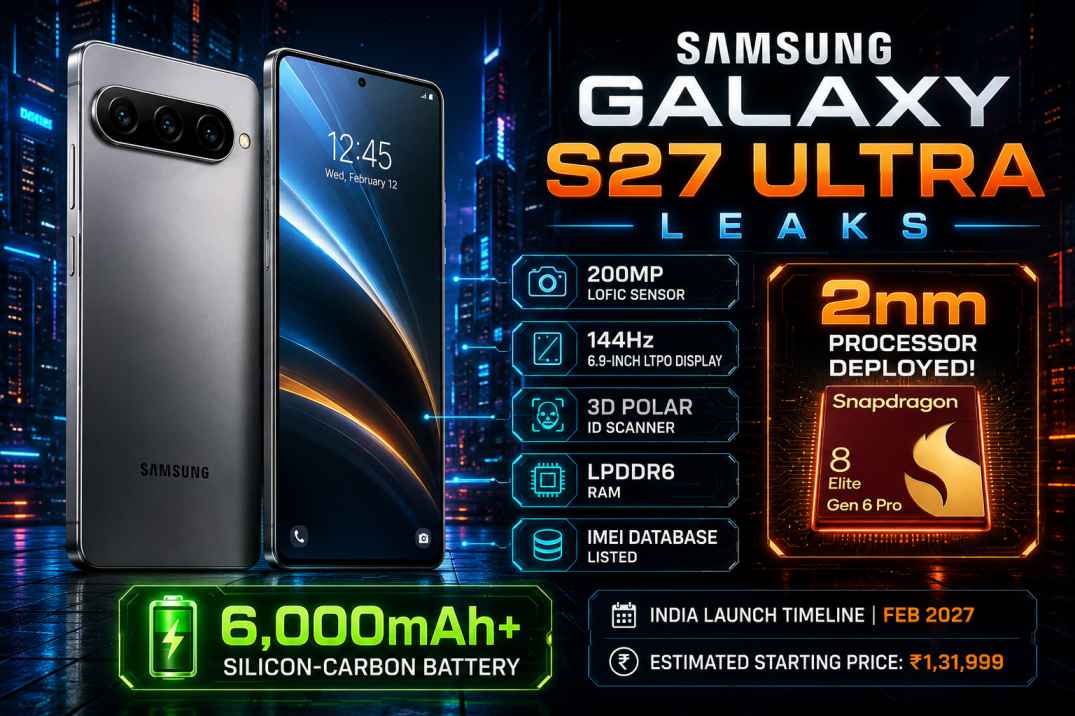
Security Evolution: 3D Polar ID Verification Setup
Samsung has made an immense jump towards the development of its face-tracking authentication technology, called Polar ID.
Polar ID is based on polarized near infrared light and was developed in collaboration with optical companies for the analysis of polarization signature of human skin.
- Anti-Spoofing Protocol: Due to the fact that this technology can detect the signature of living tissue, it is simply impossible to deceive the system by using high resolution 2D displays, digital prints or even a silicone mask. Invisible.
- Structural Footprint: The scanner is 50% smaller than multi-lens array systems. It enables Samsung to incorporate secure 3D tracking technology into the punch hole of a smartphone’s screen without creating a notch.
Samsung Galaxy S27 Ultra vs Samsung Galaxy S26 Ultra: What’s New and What’s Same?
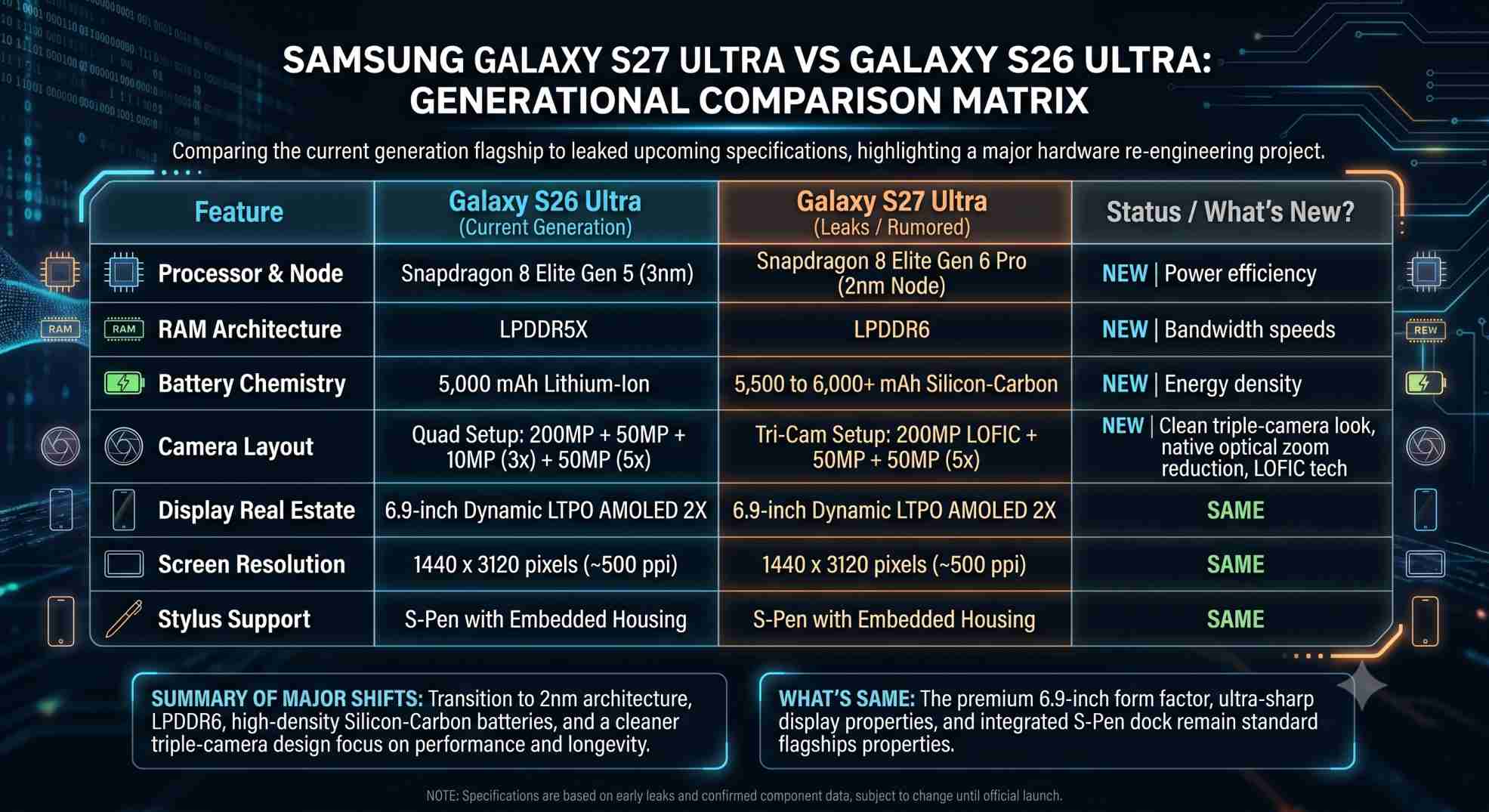
Generational Comparison Matrix:
| Feature Parameters | Samsung Galaxy S26 Ultra (Older Gen) | Samsung Galaxy S27 Ultra (2027 Flagship) | Status / What’s Changed? |
| Processor & Node | Snapdragon 8 Elite Gen 5 (3nm Architecture) | Snapdragon 8 Elite Gen 6 Pro (2nm Node) | ⚡ NEW: Massively increased processing efficiency. |
| RAM Type | LPDDR5X Configuration | LPDDR6 Architecture | ⚡ NEW: Completely eliminates background data bottlenecks. |
| Battery Power Block | 5,000mAh Lithium-Ion | 6,000mAh+ Silicon-Carbon | ⚡ NEW: Higher energy density inside the exact same physical thickness. |
| Magnetic Charging | Qi2 Standard Charging Unsupported | Full Qi2 Support Embedded | ⚡ NEW: Natively maps with magnetic charging networks. |
| Camera Configuration | Quad Setup: 200MP + 10MP (3x) + 50MP (5x) + 50MP | Tri-Cam Bar Layout: 200MP LOFIC + Dual 50MP | ⚡ NEW: Drops the old 3x macro sensor for higher in-sensor 200MP cropping. |
| Biometric Engine | Standard Under-Display Ultrasonic Scanner | 3D Polar ID Skin Mapping | ⚡ NEW: Secure 3D secure facial mapping inside a single punch-hole cutout. |
| Display Footprint | 6.9-inch Dynamic LTPO AMOLED 2X | 6.9-inch Dynamic LTPO AMOLED 2X | 🔄 SAME: Screen real estate and form dimensions remain identical. |
| Screen Resolution | 1440 x 3120 Pixels (~500 ppi density) | 1440 x 3120 Pixels (~500 ppi density) | 🔄 SAME: Layout sharpness parameters are unchanged. |
| Peak Brightness | 2600 Nits High Baseline | 2600 Nits High Baseline | 🔄 SAME: Display readability profiles match the predecessor. |
| Stylus Integration | Embedded Housing for S-Pen | Embedded Housing for S-Pen | 🔄 SAME: S-Pen storage mechanism remains structural. |
Summary of Major Shifts:
What’s New: The transition to a 2nm architecture processor, LPDDR6 memory, and higher-density Silicon-Carbon batteries marks a heavy focus on performance and longevity. On the photography side, the move to a cleaner triple-camera look by shedding the legacy 3x optical hardware is a distinct design pivot.
What’s Same: If you prefer a massive screen footprint, the premium 6.9-inch form factor, ultra-sharp display properties, and integrated S-Pen dock carry over with minimal changes to the raw dimensions.
Expected India Launch Timeline
It is expected that the line up would adhere to the premium release model. Both the global launch event and India launch events are expected to get going from early February 2027. The devices are expected to be made available through Samsung India official website portals, premium offline flagship experience stores, and Flipkart’s e-commerce platform.
Conclusion: Setting the Premium Benchmark for 2027
The coming flagship is expected to be much more than a typical hardware iteration at each season. From the confirmed entries in the databases as well as leaks of certain components, it is evident that Samsung is doing everything possible to set new benchmarks in premium phones.
By incorporating cutting-edge 2nm chipset configuration, high-capacity battery configurations, as well as intelligent placement of the triple camera modules, the device is designed in such a way that it will be able to process computing cycles as well as gaming tasks seamlessly. Even though the price may be high for ordinary customers, it is worth every penny invested by hardcore users.
My Opinion: A Radical Leap or Just Catching Up?
Core Technology-wise, the proposed changes to the Samsung Galaxy S27 Ultra are incredibly ambitious and yet incredibly overdue at the same time. For many generations now, Samsung used to rely on incremental updates that were allowing aggressive competitive brands to monopolize the performance charts.
- High-Impact Changes: Making a switch to an ultra-highly dense 2nm process node using the Snapdragon 8 Elite Gen 6 Pro is a brilliant engineering choice. Together with the compact Silicon-Carbon battery module, Samsung is finally addressing the issue of the user battery anxiety without sacrificing the form-factor of the device. Moreover, moving away from the traditional 3x camera hardware to high-fidelity, lossless 200MP in-sensor cropping demonstrates that Samsung is more interested in the optimization than matching specs.
- Potential Weaknesses: However, removing the second telephoto lens altogether might annoy users that regularly need native optical macro adjustments. Moreover, the idea of putting the high-tier biometric tracking solution like Polar ID 3D scanning in such a tiny punch-hole is going to be quite a challenge hardware-wise. The poor firmware calibration can cause issues in processing in real-life lighting conditions.
All in all, it is a great change and clearly shows that Samsung is listening to its core fans.
Frequently Asked Questions (FAQs)
What are the main upgrades in the Samsung Galaxy S27 Ultra?
Some of the major enhancements are the transition to a 2nm Snapdragon 8 Elite Gen 6 Pro chip, an increased 6,000+mAh+ Silicon-Carbon battery pack, complete Qi2 wireless charging magnet alignment, and an improved three-lens camera with a Variable Aperture 200MP LOFIC primary camera sensor.
When will the Samsung Galaxy S27 Ultra launch in India?
Based on traditional premium release cycles and database tracking sequences, the entire lineup is officially expected to go active globally and launch across major Indian commercial frameworks in early February 2027.
Is the 3x telephoto camera removed from the Galaxy S27 Ultra?
Yes, recent leaks about the hardware have shown that Samsung is abandoning the second 10MP 3x telephoto camera. It will use the main 200MP camera’s high-resolution digital lossless in-sensor cropping for middle-distance zoom metrics without any difficulty.
What is the new Polar ID security system in the Galaxy S27 Ultra?
Polar ID is a sophisticated 3D facial recognition technology driven by hardware. Polar ID uses near-infrared polarized light to check the characteristics of the skin tissues and offers the same facial security as that of Apple’s FaceID, but in a single punch-hole design.
Is there a new model launching alongside the S27 Ultra?Is there a new model launching alongside the S27 Ultra?
Yes, global IMEI database registries have confirmed the introduction of a brand-new Samsung Galaxy S27 Pro variant. This model is designed to offer a more compact footprint while retaining premium tier cameras and hardware chips, effectively replacing the previous ‘Plus’ variants.
Read Also: Android 17 Features