
As revealed by official sources from the Ministry of Electronics and Information Technology (MeitY), this immediate measure to have Telegram blocked in India has been taken in connection with ongoing national security investigations regarding the NEET medical examinations.
This sudden move of blocking the platform has brought many doubts in the minds of millions of students, tech lovers, and channel managers in India. In our detailed report on Telegram Block in India, we will take a look at the reason behind this directive, regulations, and availability status.
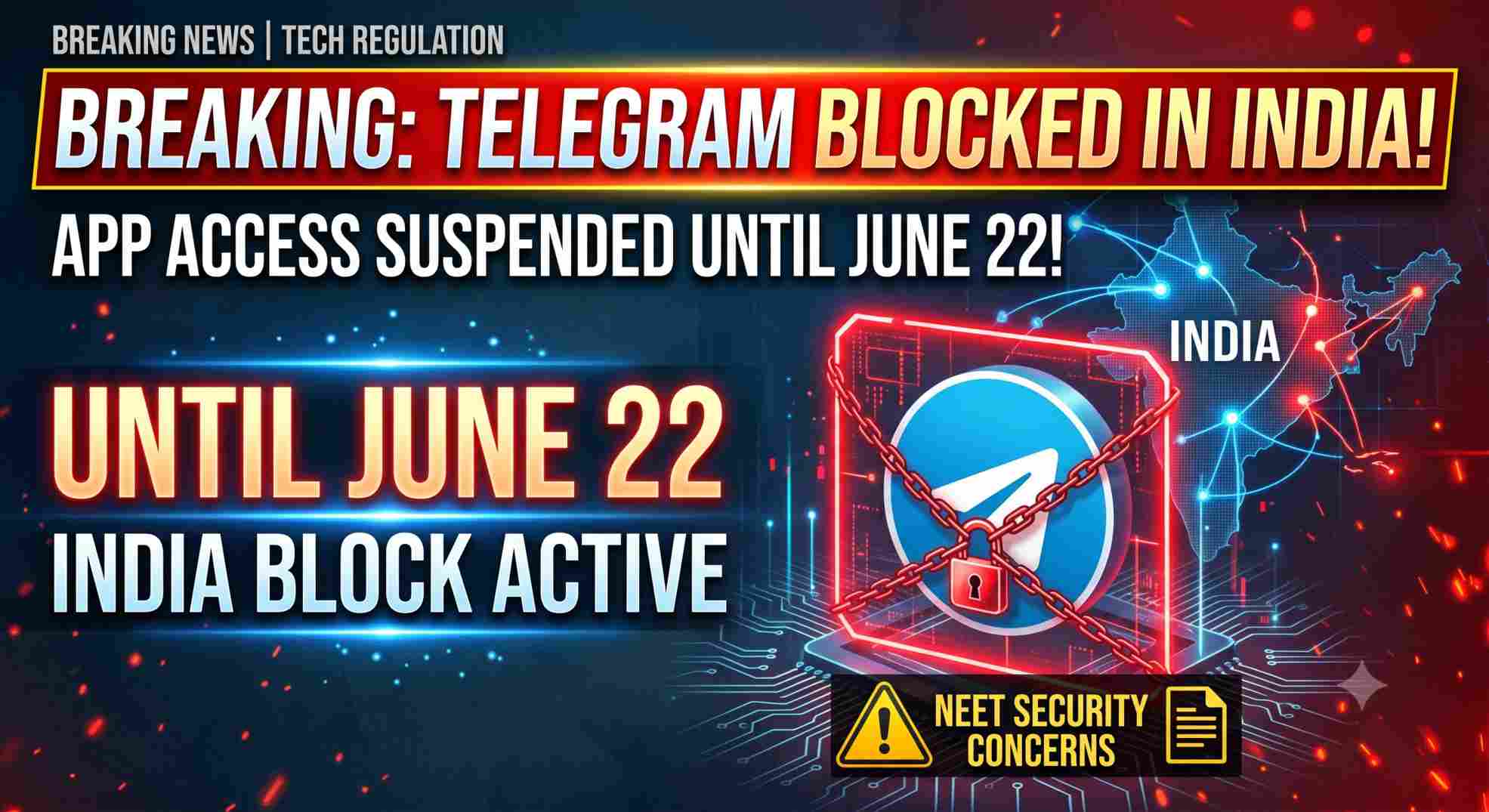
The Core Trigger: Why India Suspended Telegram Services
The move to suspend the use of Telegram for a certain period of time was not an isolated one; rather, it is part of a bigger plan that the leading investigative wings of the nation have been undertaking in the recent past. These wings include the NTA and the cyber crime wing.
Major Concerns Highlighted by Authorities:
- Leaking Exam Papers: Based on intelligence, it was revealed that many syndicated organizations were employing their automated private and public Telegram channels to systematically make money from selling, leaking, and bidding for exam modules from the extremely sensitive NEET pipeline.
- Non-Cooperation with Law Enforcement: It is noteworthy that officials from the government have highlighted on multiple occasions that Telegram’s peer-to-peer design and the company’s late response to localized court orders made it extremely difficult for Indian cyber-cells to counter any illegal organizations.
- Anonymity and Bot Exploitation: Masses of bots were being used by criminals to distribute multi-gigabyte encrypted files consisting of confidential administrative tracking sheets and answer keys.
In order to avoid any additional threats to the structure of future education programs and ensure that the structure is secure during the forensic investigation process, the top committees suggested an access block.
Quick Status Summary: Telegram Access Interruption
| Regulatory Parameter | Official Action & Scope |
| Enforcing Authority | Ministry of Electronics and Information Technology (MeitY), Government of India |
| Legal Status | Temporarily Restricted / Emergency Block Initiated |
| Target Platforms | Telegram Mobile Apps (Android/iOS) and Telegram Web Frameworks |
| Official Cause | Cyber-forensic inquiries into leaked NEET material & channel networks |
| Enforcement Period | Immediate Effect until Midnight of June 22, 2026 |
| Primary ISPs Affected | Reliance Jio, Bharti Airtel, Vodafone Idea (Vi), BSNL, and major broadband nodes |
How the Block is Being Executed: ISP Tier Restrictions
In response to the emergencies declared by the government in light of Section 69A of the Information Technology (IT) Act, ISPs and telecoms operating across India were ordered to block access to the core data centers and routing points of Telegram.
This has led to service interruptions faced by end-users seeking to update or synchronize their data sheets, which include the following issues:
- Connection Problems: The app stays stuck at the “Connecting…” status message while incoming chats do not appear on the main dashboard interface.
- Blocked Downloads: For users who have access to their saved text chat channels, downloading associated documents or media files has become impossible through the server ISP gateway.
- Blocked Web Portal: Users accessing the desktop version of the app, web.telegram.org, are greeted with generic network timeout or blocked network error messages.
Legal Provisions: Understanding Section 69A of the IT Act
The central government normally uses the provisions of the IT Act to safeguard the sovereignty of the country, the defense infrastructure, and public order. In accordance with this provision, the government enjoys the right to pass secret orders to the intermediaries to disable communication links that pose a threat to the well-being of the nation.
Since the NEET exams are competitive national exams that are part of the career structure of millions of Indian students, any organized attempt at exploiting this system digitally constitutes a serious violation of cyber security standards. At present, the situation has been considered an emergency measure up to the end of June 22.
What Happens Next? The Roadmap Leading to June 22
Block in Access to Telegram acts as a strategic cooling off time for cyber forensic experts who need time to investigate and trace the chain of command of the illegal leak syndicates.
- Forensic Audit: Corporate compliance experts from the Telegram legal department are bound to work with the Indian cyber crime wings to delete all groups involved in the scandal and provide the IP addresses of the servers in which the rogue actors operate.
- Review in June 22: The high level inter-ministerial panel is due to carry out its first major review on the progress of Telegram compliance with national security guidelines on June 22, 2026. If Telegram meets the requirement, the block shall automatically be lifted.
Conclusion: A Push for Digital Accountability
The sudden shutdown of the Telegram application highlights the growing no-nonsense policy of the Indian government regarding any cyber threats that might undermine their national education system. Although this will cause minor trouble for users temporarily, the bigger picture involves ensuring exam safety. Now, all attention is focused on June 22, when the review process will determine the outcome for the tech firm.
My Opinion: Is Temporarily Blocking Telegram the Right Move?
Although the emergency measure taken by the government invoking powers under section 69A of IT Act shows the immense level of stress of conducting the flawless NEET-UG 2026 re-examination on June 21st, it seems like a measure of two sides – a sword with two edges.
- The First Advantage: From the purely enforcement point of view, this is definitely an intelligent and needed pre-emptive move. Scamming syndicates running channels such as “PAPER LEAKED NEET” or “Private Mafia” were using Telegram’s huge member base and anonymity of bots for extortion of millions of rupees from desperate families. Putting an end to this psychological warfare is instant when there are only 5 crucial days left to the exam.
- The Most Intelligent Move (Disable Editing of Message): Most intelligent action by the MeitY was to make Telegram stop providing its users with the facility to edit messages till June 30th. These fraudsters usually use the unique method of posting a harmless message before the exam and editing that message later by putting the question paper once the exam ends.
- The Counter-argument: However, such a suspension at the platform level will create trouble for millions of genuine users, professionals, and students who use Telegram to access their academic resources and safe communication means.
Frequently Asked Questions (FAQs) About the India Telegram Block
Q1: Why has the Indian Government blocked access to Telegram?
The Ministry of Electronics and Information Technology (MeitY) temporarily blocked Telegram following critical inputs from the National Testing Agency (NTA) and the Indian Cyber Crime Coordination Centre (I4C). Organized cheating rackets and interstate fraud networks were actively using the platform to circulate fake paper leaks and defraud candidates appearing for the NEET-UG 2026 re-examination.
Q2: Exactly until when will Telegram remain restricted in India?
The full platform access restriction is strictly time-bound and calibrated to the exam window. The block is legally structured to end at midnight on June 22, 2026, covering the complete re-examination date (June 21) and its immediate aftermath.
Q3: Why did MeitY target Telegram’s message-editing feature separately?
In a separate structural directive, the government ordered Telegram to completely disable its message-editing feature within India until June 30, 2026. Cheating networks were previously creating fake “evidence” of paper leaks by editing innocuous older messages after an exam concluded to plant question papers while maintaining the original, older timestamp.
Q4: Has the official NEET-UG 2026 re-examination paper actually leaked?
No. The NTA has officially and explicitly stated that there is no question paper available outside the highly secured physical examination chain. Any channel claiming to sell or distribute the leaked re-test question paper is executing a cyber-fraud operation.
Q5: Will the NEET-UG 2026 re-examination on June 21 be postponed due to the ban?
No, the examination schedule remains completely unaffected. The NEET-UG 2026 re-examination will be conducted on June 21, 2026, exactly as scheduled. NTA verified that over 10 lakh students successfully downloaded their admit cards within the initial 24 hours of the link opening.
Q6: How can students report fraudulent channels or paper leak claims?
If you encounter any suspicious Telegram handles, bots, or individuals demanding money for question papers, you should immediately report the fraud to the official National Cyber Crime Helpline by dialing 1930 or register a complaint via the National Cyber Crime Reporting Portal.
Read Also : Redmi Turbo 5 Launched in India