
The worldwide landscape of smartphones is seeing a rather dramatic paradigm shift with Apple and Google vying for supremacy in their respective ecosystems. With Apple having made significant advancements in its artificial intelligence infrastructure and implementing them into iOS, the much-hyped competition between Siri AI vs Gemini has finally made the transition from being just an idea to something happening right now on a daily basis at a hardware level. People are not just comparing the power of devices anymore but assessing which ecosystem offers more predictive and context-aware artificial intelligence.
To fully understand the key differences in the architecture between Siri AI vs Gemini, we need to take a look at how different Google and Apple approach AI development. The key distinction between them is that while Google uses its vast multimodal model infrastructure to provide you with information, Apple’s model works by securely processing your data on the device itself.
When making a choice between Siri AI vs Gemini, it all boils down to choosing between raw power and system control. Here’s the gist of what happens during this competition:
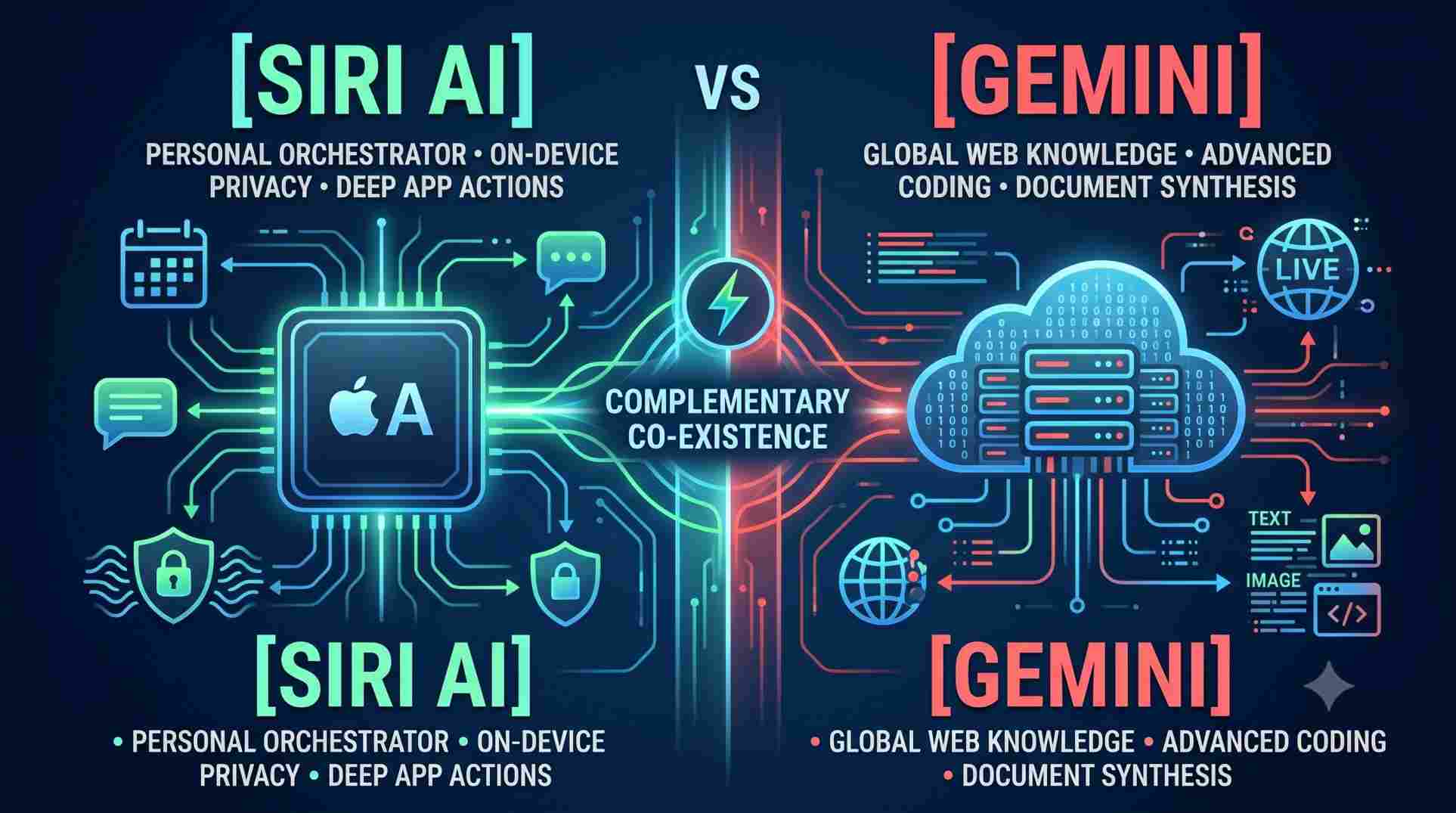
Core Integration: Apple has its engine embedded in the core system architecture, while Google is a highly versatile and flexible cross-platform overlay application.
Data Privacy: On-device processing is the fortress through which Apple protects itself, while Google is brilliant at fast server-side computing.
Contextual Awareness: Siri in its upgraded version uses semantic indexing for understanding what you do on your screen, while Gemini relies on the global search indexes of Google.
What Is Siri AI?
The voice assistant, recreated by Apple, marks a significant jump architecturally compared to its predecessors, aiming to become one of the major contenders in the Siri AI vs Gemini battle. Driven by Apple Intelligence, this technology leverages a sophisticated hybrid architecture consisting of highly-optimized models running on device and secured servers on the cloud. In contrast to ordinary messaging services, it is deeply integrated into the ecosystem of iOS, iPadOS, and macOS, thus acting as a system coordinator instead of a text generator.
In assessing the underlying infrastructure behind Siri AI vs Gemini, it is important to note the uniqueness of Apple’s system which is defined by the capability of Semantic Indexing. This technology enables the virtual assistant to securely access and analyze your personal context such as emails, calendar entries, texts, and images without ever sharing any of your private data with external databases. Thus, it establishes the on-screen loop for the system, allowing it to execute various actions inside of native and third-party applications depending on your current context.
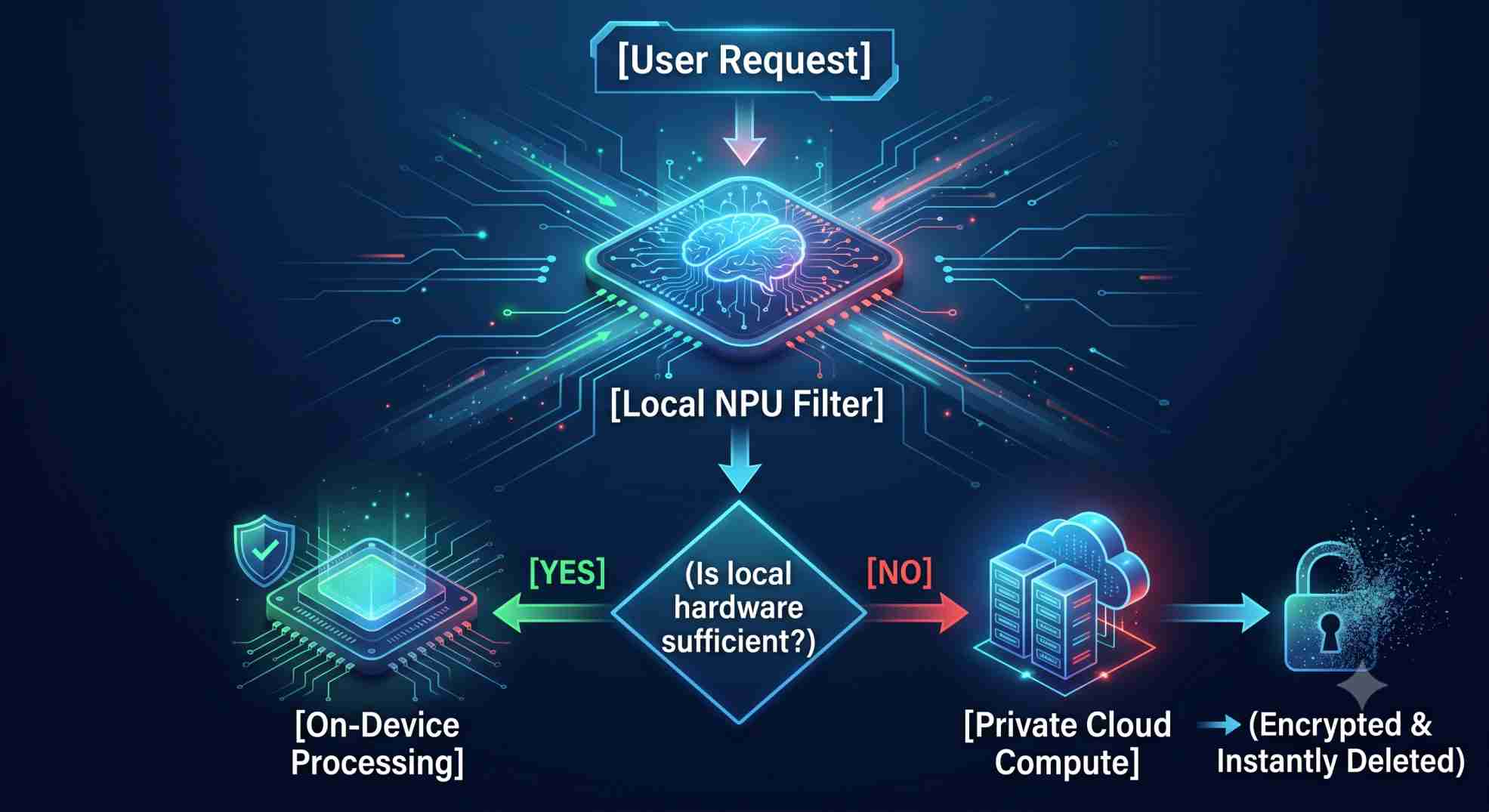
Apple relies on a proprietary security measure known as Private Cloud Compute (PCC) to ensure the company stays ahead of competitors in the Siri AI vs Gemini battle. Should a request exceed the processing capabilities of the device’s hardware, the query is sent to the company’s own cloud infrastructure, which utilizes encryption to erase any trace of your data instantly. Thanks to such an approach, the AI-based assistant manages to offer superior agency performance while adhering to Apple’s primary philosophy of absolute privacy of user data.
Ecosystem Orchestration: Ability to toggle system settings, generate texts in apps, and perform cross-application actions by saying something out loud.
On-Screen Awareness: Understands the text, photos, and files that are currently displayed on your screen so that you could act on them at once.
On-Device Core: Regular requests get resolved using the device’s neural engine for zero latency and offline capabilities.
Private Cloud Compute: Advanced requests get resolved using dedicated cloud servers while ensuring absolute anonymity and no data caching or logging.
What Is Google Gemini?
Google Gemini, which is an artificial intelligence framework by the California technology conglomerate, is the company’s top-of-the-line multimodal AI architecture and a formidable contender in the Siri AI vs Gemini race. Being built from scratch to naturally handle text, coding, speech, imagery, and videos at once, Gemini works as a very proactive cognitive agent. The lineup features several versions ranging from Nano, Flash, Pro, and Ultra that are used for Google’s mobile apps interface, website front-end, and company workspace tools.
The crucial difference between Siri AI and Gemini is the tremendous computing power and the live web access enjoyed by Gemini. Working mainly in the cloud, Gemini analyzes complex queries, executes code, and generates content with remarkable flexibility in linguistic capabilities. Contrary to strict hardware limitations, this artificial intelligence framework does not operate in the local environment and brings a multi-million token context window via live streaming to consumer hardware.
As a part of the evolution of the Siri AI vs Gemini, Google has used Gemini to fully supplant the traditional Google Assistant abilities on Android devices. It acts as an omnipresent AI layer that is able to write lengthy texts, read and analyze long PDF research papers, generate photorealistic images using Imagen 3, and make comprehensive travel plans. As a result of connecting the AI to Google’s incomparable index of searches, it proves to be excellent for giving quick answers to fast-changing global events that take place in real life.
Multimodal Understanding: Has the ability to understand text, complex programming code, complex graphics, and real-time audio input all in one continuous process.
Context Window: Can easily analyze and remember extensive texts, entire books, or hours-long video content in one session.
Search Integration: Works seamlessly with Google Search Extensions, making sure all of the answers given are verified by checking current web data.
Versatility: Functions smoothly both as an app on iOS, replacement AI for the system on Android, and extension for web browsers around the globe.
Siri AI vs Gemini: Key Differences at a Glance
To properly analyze Siri AI vs. Gemini, it is necessary to understand how the design philosophies of the two determine their respective performances. Below are the specifications and behavioral aspects that determine Siri AI and Gemini in 2026.
| Technical Parameter | Apple Siri AI | Google Gemini |
| Primary Architecture | Hybrid (On-Device + Private Cloud) | Cloud-First (Server Driven Matrix) |
| Data Processing Core | Apple Intelligence & Local NPU | Gemini Flash, Pro, and Ultra Engines |
| Context Window Size | Variable (Focuses on Personal Semantic Data) | Up to 1M+ Tokens (Massive File Analysis) |
| Core Distribution Platform | Apple Hardware Exclusive (iOS/macOS) | Cross-Platform (Android, iOS, Web) |
| Privacy Model | Private Cloud Compute (Zero Caching) | Standard Cloud Processing (Account Opt-out) |
| Internet Access Method | Curated Extensions (e.g., Optional Search) | Direct Live Google Search Integration |
Features Comparison: Siri AI vs Gemini
Exploring further into the features of the Siri AI vs Gemini battle shows that the two companies have divergent product trajectories. Apple’s emphasis is on micro-management and task automation, while Google is concentrating on content creation and multi-stage data analysis. Making a choice about which set of features to choose comes down to understanding where each platform carries out its functions best.
Voice Assistant Performance
Latency of voice response and the smoothness of the conversation become very important factors when comparing Siri’s artificial intelligence with Gemini. The former works perfectly fine with natural variations in the spoken language, keeping the history between two subsequent requests even if the speaker stumbles. In contrast, thanks to its sophisticated Live Audio channels, Gemini acts as a human conversational partner letting you interrupt him/her midway through.
AI Capabilities and Smart Features
In terms of pure creative logic between Siri AI and Gemini, Gemini definitely scores far above with regard to brainstorming and content creation. The capability of Gemini to develop thousands of lines of operational programming, translation of complicated papers into dozens of languages, and developing marketing graphics is immense. On the other hand, Siri AI concentrates only on improving the quality of text through its smart functionality.
App Integration and Productivity
The layer of structural integration is when the concept of Siri AI versus Gemini takes a complete turn in Apple’s favor. The reason for this is that Siri can access your screen information to copy the code shared by your friend and then paste it in the sheet for expenses and use Apple Pay for making the final transaction. However, Gemini needs special app extensions to access information from applications such as Gmail, Google Docs, and YouTube.
Privacy and Security Comparison
The philosophical difference between Siri AI and Gemini lies within their perspectives concerning data safety and cloud computing technology. Apple views privacy from an architectural perspective, which means that the majority of personal data questions are answered based on the calculations made on your device’s hardware Neural Engine. However, for more sophisticated cloud operations, they employ Private Cloud Compute technology where they utilize server software, audited by unbiased researchers, that ensures data is not stored or read by anyone.
On the other hand, the strategy for Siri AI against Gemini from Google lies in utilizing enormous computing capabilities on servers compared to silos. Gemini sends your data across its cloud data centers around the world to analyze big data sets, cross-check search indexes, and generate hyper-precise results. Even though Google provides robust account privacy settings, workspace data switching features, and advanced data encryption mechanisms, the system automatically analyses the user’s queries to improve its neural network unless otherwise stated by the user.
Local Safeguards: Siri locally analyzes personal profiles; Gemini performs analysis of user data blocks in its safe cloud pipelines to complete various functions.
Verification on Server: Apple supports third-party cryptography verification for its servers; Google employs state-of-the-art data center firewalls in its data centers.
Data Ownership: Apple does not allow any cloud logging of personal data; Google uses structured storage of user history to give personal feature feedback.
Real-World Performance Test
Performing a rigorous Siri AI vs Gemini AI stress test allows for the identification of practical advantages in each of their operational paradigms. When asked to “Find the flight receipt in my emails, find the hotel address, and compute the driving distance from my present location,” Siri goes about the process immediately by searching through your email database, correlating with Apple Maps, and doing all calculations internally without the use of a third-party tracking script.
When Gemini is faced with the same series of tasks during the Siri AI vs Gemini comparison test, it makes use of the Google Workspace extensions system. It finds the flight receipt in your Gmail account and correctly presents you with the hotel’s geographic position using its Google Maps extension dashboard. However, when the task at hand requires that “I draft an automated message to the hotel manager and send it via WhatsApp,” Gemini encounters a system limit as it does not have root access on third-party clients’ APIs.
Ecosystem Suitability
Siri AI vs Gemini for iPhone Users
For those passionate about hardware, the question of which is better between Siri AI and Gemini becomes solely an issue of access to the operating system. Siri for iPhones is embedded into the phone’s OS in such a way that it is able to change settings on the phone, control its memory, check its lock screen notifications, and perform Siri shortcuts. However, the Google Gemini application only exists as a sandbox application on iPhones.
Siri AI vs Gemini for Android Users
Gemini holds its own weight in comparison to Siri AI in Siri AI vs Gemini, with regards to the Android system. It functions as the main system assistant, superseding previous voice-controlled systems with contextual overlay sheets. It has the capability of reading whatever is displayed on your Android display screen, providing summaries of websites viewed via Chrome, and also syncing your pixel photos from the camera roll.
Audience Segmentation and Use Cases
Which AI Assistant Is Better for Students?
While deciding upon the winner in Siri AI vs Gemini in relation to academic work, Gemini comes out tops as the best educational assistant. For example, students have the ability to feed complete books, code files, or long research papers into Gemini, which will help them get instant summaries, create their own flash cards, or even teach them how to solve physics equations in detail.
Creating Study Guides: Gemini is able to create markdown study guides from unstructured lecture notes within a couple of seconds.
Debugging Code: It performs full syntax checking and offers alternative ways of logic for various programming languages.
Which AI Is Better for Business and Work?
For business applications, the decision between Siri AI vs Gemini depends on what you currently use as software systems. Should your company be deeply integrated with the Google Suite, Gemini will give you incomparable benefits in collaboration through automation of business writing processes. When your working space is based on Apple gadgets, then Siri’s local encryption models guarantee that all your business strategies will remain fully confidential.
Text Creation for Business: Gemini can draft client e-mails, make a presentation outline, or quickly summarize long notes from corporate meetings.
Document Encryption: Siri can process contracts and other legal documents right on your MacBook Pro without any transferring of confidential information to outside clouds.
Apple Siri AI vs Gemini: Pros and Cons
To simplify your choice in the Siri AI vs Gemini landscape, it is helpful to weigh the practical trade-offs of both intelligence platforms side-by-side.
In order to make an easy decision for yourself between Siri AI and Gemini, it will be useful to compare the advantages and disadvantages of these intelligent systems against each other.
Apple Siri AI
Strengths: Provides incomparable privacy for user data on-device; system-level manipulation of apps; zero-delay offline processing of device tasks.
Weaknesses: Tied exclusively to expensive Apple hardware; unable to perform complex code generation; narrow context window for processing big files.
Google Gemini
Strengths: Capable of processing enormous amounts of context at once in multiple modes; direct integration with current internet search data; operates everywhere.
Weaknesses: Needs constant internet access for complicated tasks; less natural control over third-party device settings; more invasive in terms of data tracking.
Can Siri AI Replace Gemini?
While AI applications continue to evolve, one common question that arises is whether Apple’s AI system is capable of making Google tools redundant in the Siri AI versus Gemini debate. The answer to this is that they are made to serve two very different purposes in your digital existence. Siri is an AI application that is meant to orchestrate your phone in order to increase efficiency in your digital life.
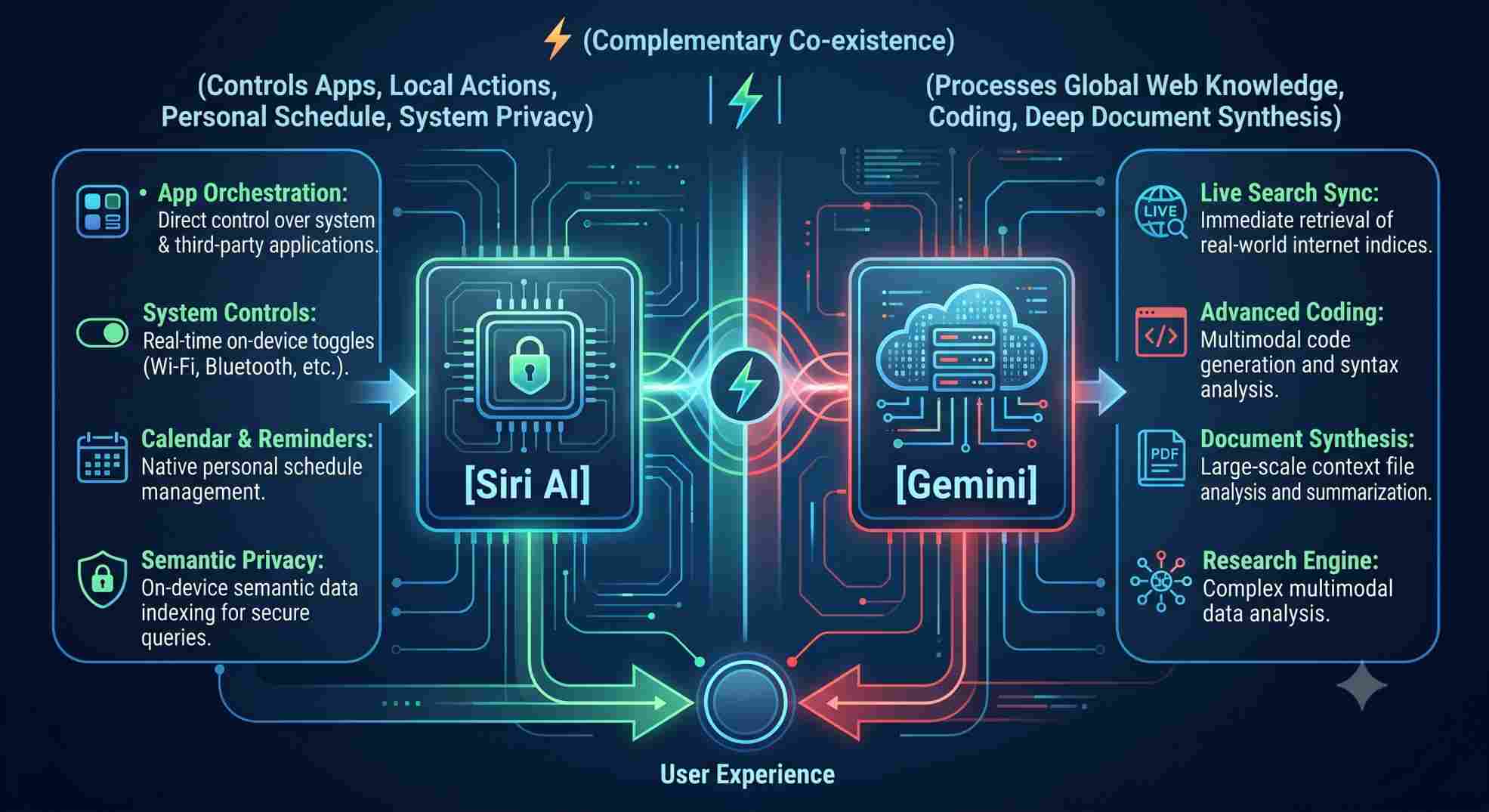
However, since Siri does not seek to create large-scale matrices with billions of parameters concerning world knowledge, it cannot compete in its broad range of research. However, since Gemini uses the cloud environment, it cannot reach the system hardware switch safely. Thus, rather than being a substitute for one another, the optimal approach for Siri AI vs Gemini is to combine them into a pair complementing each other’s functionalities.
Pricing and Availability
The level of financial accessibility is one more area that deserves close examination in the Siri AI vs Gemini ecosystem analysis. Siri AI is fully integrated into compatible Apple silicon hardware like iPhones, iPads, and M series Mac computers at absolutely no cost as a part of a system-level software update with no subscription fees whatsoever. All Advanced Private Cloud Compute operations are also included under the hardware use license framework.
Google Gemini is designed according to a two-tier monetization model, aiming to attract casual users and enterprises at once. The standard Gemini system can be downloaded at no cost for Android and iOS users worldwide. Access to the topmost model engines of Gemini (Ultra) can be purchased through subscription in the Gemini Advanced tier, which offers unlimited storage and integration options among other bonuses.
Siri AI vs Gemini: Which One Should You Choose?
Choosing who wins the Siri AI versus Gemini decision comes down entirely to your individual ecosystem allegiance and computational needs. For those who have iPhones, MacBooks, or iPads, with the top priority being safeguarding your private information and making application tasks more efficient, the Siri AI technology will serve you best. The technology simply suits your daily activity without any additional configuration or expense.
For those who find themselves engaging in intensive cross-platform activities, coding, writing, or following world events through global news trends, the Google Gemini reigns supreme. The technology is capable of providing all the mental strength needed to handle large amounts of data on any display or geographic location.
Final Verdict: Siri AI vs Gemini – Who Wins?
There cannot be a sole and absolute victor in the Siri AI versus Gemini war as the two companies have developed completely distinct varieties of artificial intelligence. For those who need a highly secure “Personal Orchestrator” that will control their phone, read their screen, and keep all personal information safe in their pockets, Siri is a no-brainer as its seamless integration with iOS makes all smartphone actions painless and fast.
As opposed to the previous one, those in need of an “Intellectual Powerhouse” which will do coding, review 500-page-long books, come up with creative business ideas, and provide up-to-date answers from the internet – Google’s Gemini is the only choice.
Frequently Asked Questions (FAQs)
Q1. Is Siri AI better than Gemini?
Siri AI is significantly better at executing deep system tasks, controlling native device applications, and safeguarding user privacy via local hardware processing. However, Google Gemini is far superior when it comes to creative long-form writing, programming support, complex multimodal file analysis, and retrieving real-world live internet data.
Q2. Is Gemini powering Siri AI?
No, Gemini does not power Siri AI. Siri runs on Apple’s proprietary Apple Intelligence framework, utilizing custom-designed on-device models and secure Private Cloud Compute servers. While Apple allows optional extensions to third-party models like ChatGPT for specific creative requests, the core architecture remains entirely separate from Google
Q3. Can iPhone users use Google Gemini?
Yes, iPhone users can easily access Google Gemini by downloading the official standalone Gemini application from the Apple App Store, or by logging into the Gemini web interface via mobile browsers. However, due to iOS security boundaries, Gemini cannot perform system adjustments or control native iPhone settings like Siri can.
Q4. Which AI assistant is best in 2026?
The best assistant depends entirely on user utility. For deep app integration and unmatched data security within the Apple ecosystem, Siri AI takes the crown. For cross-platform flexibility, massive text generation, heavy research workflows, and complex multimodal tasks, Google Gemini remains the industry leader.
Read Also: Siri AI vs ChatGPT: Which is Better in 2026