
Apple is just about to unveil one of its biggest software rollouts of recent times. As the international smartphone market continues to shift towards local machine learning frameworks, the upcoming release of the iOS 27 Beta Updates channel will be an architectural game changer for iPhones. In light of a historic collaboration between Google and Apple involving artificial intelligence, the current software cycle focuses less on interface changes and more on system automation and bespoke layout engines tailored for cutting-edge hardware form factors.
For international technology aficionados, developers, and early adopters seeking the installation of the configuration profiles, staying aware of the constantly shifting developer build timeline becomes crucial. The following guide gives insight into the confirmed updates, their deployment time frame, and the list of compatible devices for iOS 27 Beta Updates.
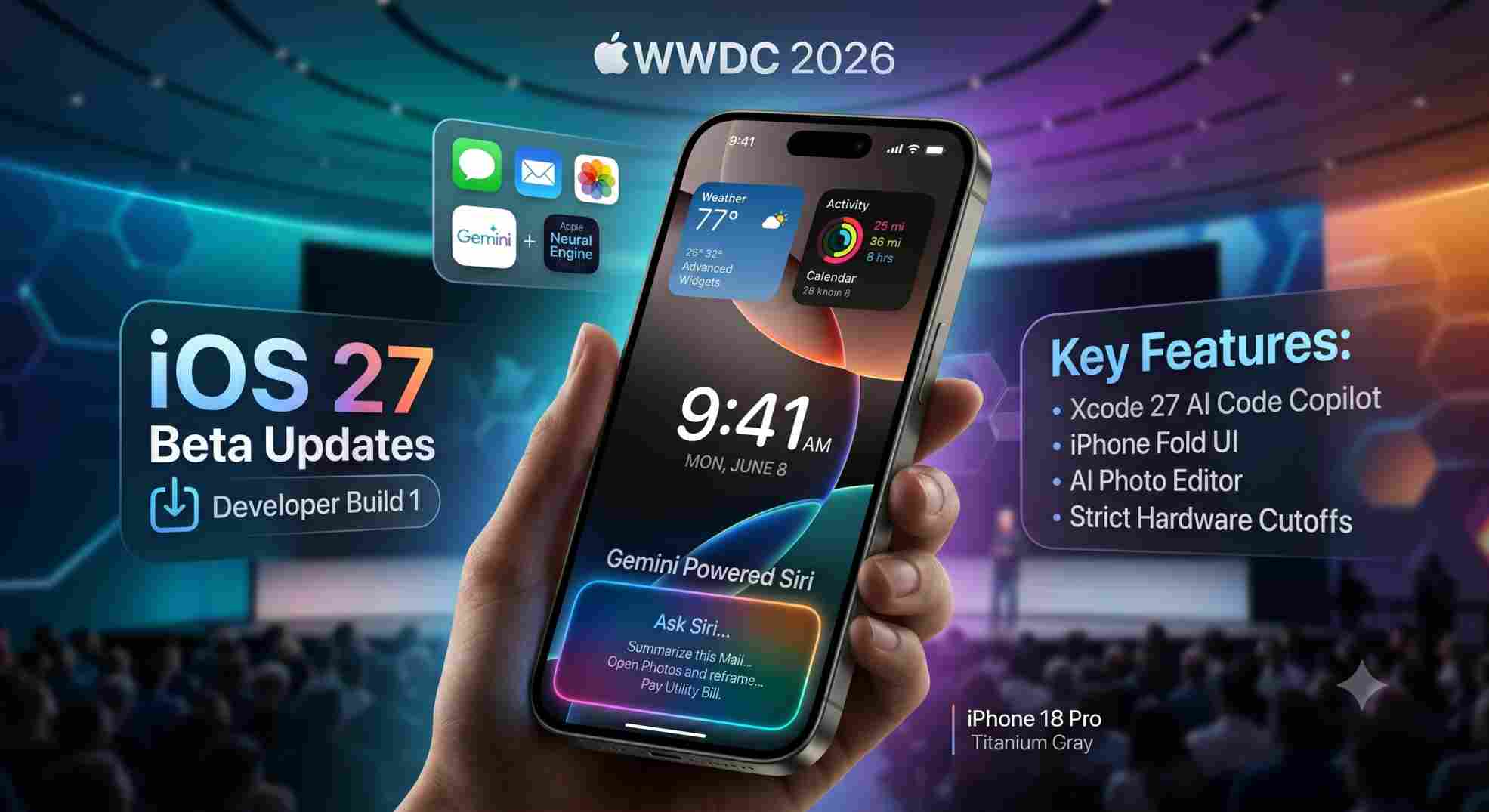
The Big Overhaul: Siri Transforms Into A Gemini-Powered AI Chatbot
Without a doubt, the biggest gem of the iOS 27 Beta Updates release is the radical transformation of Apple’s voice assistant. Moving away from its traditional glowing ball design, Siri is transitioning into a chatbot-driven conversation model:
Cross-App Functionality within Ecosystem: Thanks to Google’s Gemini models tailored for Apple’s devices, Siri is capable of processing tasks spanning multiple apps. For example, users can command Siri to look up a utility bill receipt in the Mail app, collect relevant payment information, and enter it into a tracker sheet within the Numbers app.
Chatbot Interface Within Dynamic Island: Rather than occupying the entire display, the redesigned Siri chatbot system will reside within the Dynamic Island space, processing natural language conversations through multiple interactions with context awareness.
Built for the Future: Native Multi-Window Layouts for the iPhone Fold
Given the intense speculations about an imminent dual display foldable device in the coming months, it is worth noting that Apple has been quietly planning the basics of the iOS 27 Beta Update regarding dynamic screen sizing:
Parallel Execution of Applications: This feature borrows heavily from the iPadOS specifications, as iOS 27 now supports the use of split screen for executing two independent applications at once.
Updates for the Liquid Glass Interface: The Liquid Glass interface elements, which were originally introduced last year, have been retained; however, this version now features a graphics slider which allows for scalability of the visual transparency process, optimizing battery usage.
Next-Gen Camera and Advanced AI Photo Editing Tools
There will be a huge influx of computational power to the mobile photography workflow generation inside upcoming developer versions:
Customizable Camera Interface: The native Camera app UI design is now being modularized where professional photographers can customize certain tool placements, widgets, and exposure toggles according to their own needs.
Generative ‘Extend’ and ‘Reframe’ Features: In the Photos system, there are some new AI editing capabilities for photographers that enable the creation of extra background details outside the initial picture frame (Extend) or reorientation of the compositional angle through textual commands.
Official Deployment Schedule and Release Timeline
To track the exact availability matrix of the iOS 27 Beta Updates rollout, follow this verified historical deployment schedule:
| Software Release Stage | Expected Deployment Phase | Target User Group Access |
| Developer Beta 1 Build | June 8, 2026 (Post-Keynote) | Registered Apple Developers |
| Public Beta Testing Profiles | Mid-July 2026 | General Open Beta Enthusiasts |
| Final Stable Global Rollout | September 2026 | Public Over-The-Air (OTA) Release |
System Compatibility: Will Your Current iPhone Get the Update?
Due to the intense need for computing power from the local workflow and complicated multi-window rendering, Apple is carrying out its toughest-ever hardware cutoff line in recent history:
Eligible iPhone Models (Confirmed Support)
- iPhone 18 Series / iPhone Fold (Pre-installed)
- iPhone 17 Series (Including iPhone 17, 17 Pro, 17 Pro Max, and iPhone Air)
- iPhone 16 Series / iPhone 15 Series (Full Apple Intelligence support restricted to Pro variants)
- iPhone 14 Series / iPhone 13 Series / iPhone 12 Series (Standard platform execution only)
The Cutoff Line (Devices Losing Support)
The rumor coming from the supply chain leak says that the famed iPhone 11 series (iPhone 11, 11 Pro, and 11 Pro Max), along with the second generation of iPhone SE (2020), will officially be cut off from any upgrades this year.
Conclusion: Final Trajectory for the Smartphone Moat
In summary, the advent of the iOS 27 Beta Updates framework marks an immensely progressive platform basis from the perspective of Apple’s product portfolio. Through harnessing premium-level conversational capabilities, forming effective multi-tasking user interfaces for foldable form factors, and maximizing battery performance in background mode, Apple has managed to create an impenetrable platform design layout. Provided that you have a compatible model, you will definitely experience an entirely new definition of mobile productivity after getting hold of the initial updates.
My Opinion: A Tech Expert’s Take On Apple’s Strict AI Hardware Moat
In terms of analysis, the new features implemented through the iOS 27 Beta Updates reveal that Apple is no longer considering mobile software as just another second-tier product offering. The revamp of Siri to include full-on chatbot capabilities with the ability to scan files on a local drive finally fixes a large gap in software security that Android producers have been exploiting for several months now.
Nevertheless, we must not forget about the heavy-handed approach to consumer money-making implemented within this update. As all the most interesting and promising features—such as screen recognition in real-time and powerful image extension—are only available on machines equipped with ample amounts of RAM memory, Apple is basically coercing users into upgrading their hardware once again. Having an older iPhone 12 or 13? Then iOS 27 will feel nothing more than an optimization patch for you.
Frequently Asked Questions (FAQs)
Q1. How can users officially install the iOS 27 Developer Beta profile after the WWDC 2026 Keynote?
Ans. To download the iOS 27 Developer Beta build, users need to enroll their Apple ID into the official Apple Developer Program (which now offers a free tier). Once registered, navigate to Settings > General > Software Update > Beta Updates on your compatible iPhone and select the iOS 27 Developer Beta profile to trigger the over-the-air (OTA) download.
Q2. When will the iOS 27 Public Beta profile become available for general users?
Ans. While developers get immediate access post-keynote on June 8, 2026, the official iOS 27 Public Beta configuration profiles are scheduled to launch in mid-July 2026. This gives Apple enough time to patch major stability and battery drain bugs discovered in the initial developer builds.
Q3. Will the Gemini-powered Siri chatbot operate completely on-device under iOS 27?
Ans. The new Siri architecture utilizes a hybrid processing pipeline. Basic operational tasks, file parsing, and local scheduling run completely on-device to maintain strict user privacy. However, highly complex reasoning models and deep cross-application contextual assistance rely on secure, cloud-tethered server infrastructure optimized through Apple’s neural partnership.
Q4. Which older iPhone models will officially lose support with the iOS 27 update?
Ans. The iPhone 11 lineup (iPhone 11, 11 Pro, and 11 Pro Max) along with the second-generation iPhone SE (2020) have officially hit the cutoff line. These models will remain on legacy security patches and will not be eligible to upgrade to the iOS 27 ecosystem due to neural hardware limitations.
Read also: Apple WWDC 2026 Highlights Keynote