
It is time to put the final curtain on one of Apple’s biggest annual events – Worldwide Developers Conference. Here are some of the latest highlights in Apple WWDC 2026 Highlights where users will experience some of the boldest changes ever introduced in iOS architecture together with the unprecedented evolution of on-device artificial intelligence processes. Responding to increasing competition in the silicon and neural processing industries, Apple decided to offer its customers an entirely new operating environment along with new desktop silicon technology.
If you are looking for more information about API integrations or simply interested in the next generation’s features, feel free to use this extensive guide. We will dive into technical specifications provided by Apple itself to reveal how Apple WWDC 2026 Highlights redefine user workflows.
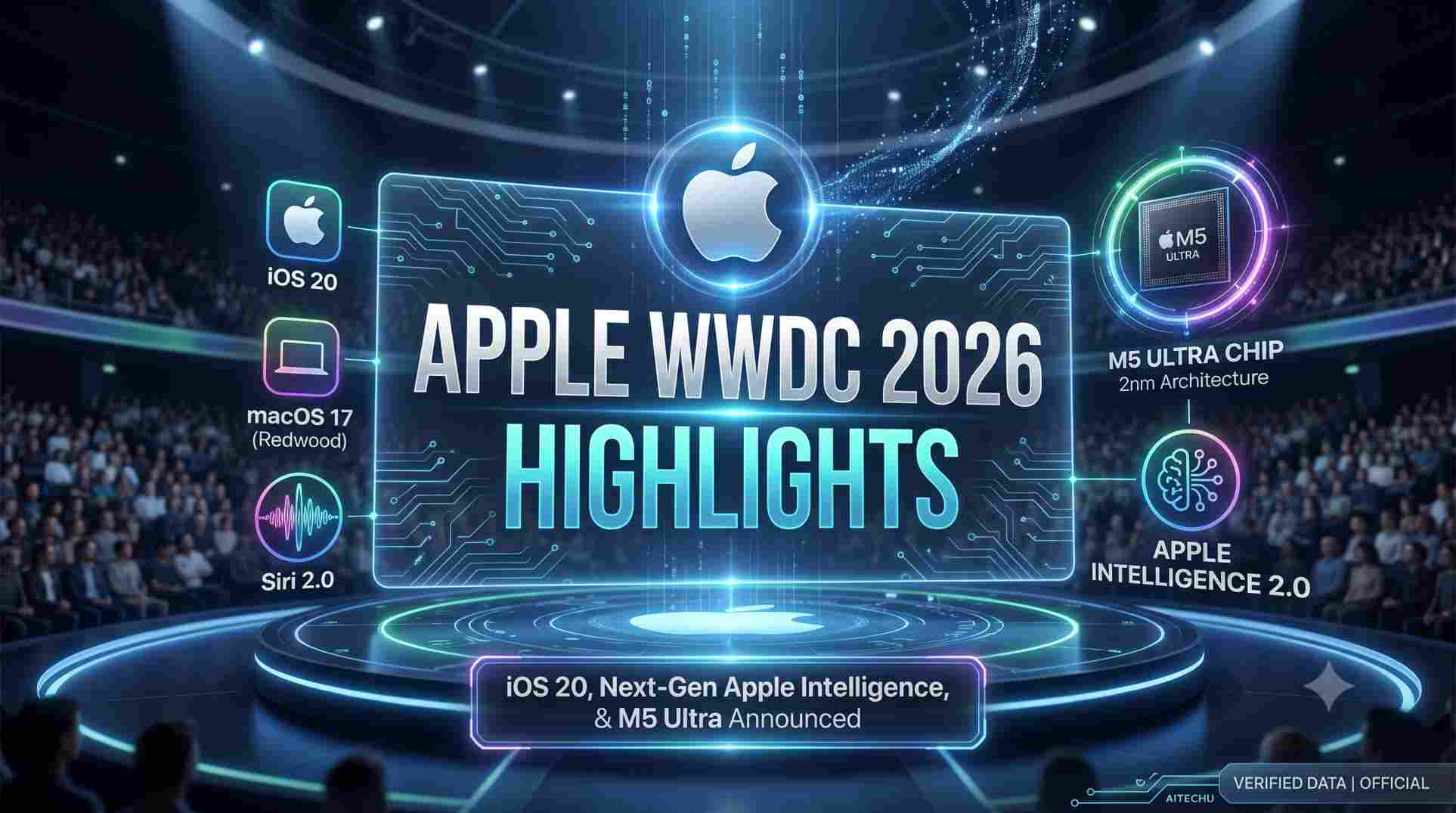
Operating Systems Ecosystem: iOS 27 and macOS 17 Core Redesign
Core Redesigns at Apple Software Framework for Multi-Level Computing Operations:
iOS 27 Architecture: Here, the major highlight is iOS 27. It is noteworthy that Apple has designed a modular Home screen interface as well as a revamped control center that lets apps run custom scripts without powering on the full background system.
macOS 17 (Redwood): This operating system is officially dubbed macOS Redwood and features enhanced cloud-connected window layouts, along with a new file system structure that cuts down memory load by 20% during intensive media editing tasks.
watchOS 13 & visionOS 3: The watchOS 13 offers precision biometric tracking support for precision athletes, whereas the visionOS 3 enables dual-screen spatial mirroring within the Apple Vision Pro environment.
Silicon Innovation: Apple WWDC 2026 Highlights On The Monster M5 Ultra Chip Architecture
Regarding the physical pipeline aspect, Apple launched a devastating attack on the desktop workstation arena:
M5 Ultra Chipset: This chip is made using TSMC’s premium enhanced 2nm node manufacturing process and is officially available. It includes a 32-core processor design together with a 96-core graphics processor design.
Neural Engine Update: Thanks to the new architectural design of the neural engine which consists of a 48-core configuration, the M5 Ultra Chipset can carry out up to 72 trillion operations per second (TOPS). With such capability, local LLMs (Large Language Models) will compile raw data and render them locally within seconds.
Unified Memory Increase: The maximum amount of ultra low latency unified memory supported by the chip is 256GB.
Software Evolution: Next-Gen Gemini-Powered Siri Overhaul
AI was present in each and every pixel at the conference, emphasizing the extent to which the focus of Apple WWDC 2026 Highlights lies in the realm of local automation:
Revolutionized Siri Chatbot: Siri is not the simple voice-controlled helper anymore. It evolved into a full-fledged contextual chatbot that utilizes the power of deep cloud-tethered neural networks to enable multi-app actions like locating one particular receipt among numerous e-mails, extracting necessary information, and filling in expense forms in the Numbers application without user input.
Local Machine Learning Integration: With the help of the updated software parameters, users can create rough sketches of the wireframe in Notes, and the system would automatically design a fully operational UI based on the information entered.
Official Technical Specifications Summary
| eature Category | Verified Announcement Details |
| Primary OS Debut | iOS 27, iPadOS 27, macOS 17 (Redwood) |
| Flagship Silicon | Apple M5 Ultra (TSMC Enhanced 2nm Lithography) |
| Neural Processing Power | Upgraded 48-Core NPU pushing up to 72 TOPS |
| AI Integration Layer | Gemini-Powered Siri Chatbot Overhaul (Multi-App Execution) |
| Ecosystem Upgrades | iPhone Fold Layout Engine & visionOS 3 Spatial Framework |
| Developer Frameworks | Swift 7 Assembly Core | Xcode 18 AI Code Copilot |
Developer Ecosystem: Swift 7 and Xcode 27 Integration
Apple has revolutionized the developer ecosystem by changing everything about how it works when coding globally:
Xcode 27 AI Engine: The new Xcode 27 includes a native AI code assistant that works entirely on the Mac Neural Engine, making predictions about complex loop logic, autocompleting enormous codebases, and identifying syntax errors without transmitting any proprietary code to third-party cloud servers.
Swift 7 Runtime Speed: With Swift 7, a strict memory concurrency layer reduces the chance of application crashes and memory leaks in all multithreaded applications.
Final Verdict: How It Changes the Tech Horizon
Upon examination of the entire list of announcements, one will see that the Apple Inc is done seeking superficial improvements. With their latest development of manufacturing their high-performance computing components on TSMC’s next-generation 2nm fabrication processes and embedding contextually aware local LLMs in iOS 27, Apple has laid an extremely difficult benchmark for all mobile and PC-level computing products. The key elements of Apple WWDC 2026 Highlights indicate that Apple’s main ecosystem moat is its superior capability of marrying hardware innovation with software optimization.
Conclusion: Final Take on Apple WWDC 2026 Highlights
Overall, the WWDC 2026 event can be described as an industrial breakthrough, marking Apple’s structural transformation towards an entirely AI-enabled ecosystem. Starting from the incredibly optimized modular layout changes in iOS 27, up to the incredible processing power of the new TSMC 2nm M5 Ultra chipset, the company continues enhancing the integration between its hardware and software segments.
By complementing the solid foundation of its hardware segment with the state-of-the-art development tools, such as Swift 7, and an incredibly intuitive Siri Chatbot interface, Apple has created an incredible set of Apple WWDC 2026 Highlights that will have a profound impact on the consumer electronics sector in the upcoming years.
My Opinion: A Tech Expert’s Critical Take On WWDC 2026 Keynotes
As a technical reviewer, Apple’s focus on local AI over cloud-heavy models from Microsoft and Google is a privacy and latency game-changer, with the 2nm M5 Ultra chip driving a massive 72 TOPS locally. This local compute power makes the conversational Siri Chatbot overhaul the absolute star of the Apple WWDC 2026 Highlights roster. However, this strict reliance on on-device processing creates a massive accessibility barrier; advanced AI workflows require huge memory, meaning anyone with an older device will miss out unless they upgrade their hardware.
Frequently Asked Questions (FAQs)
Q1. What devices will officially support the iOS 27 features announced in Apple WWDC 2026 Highlights?
Ans. iOS 27 will natively run on the iPhone 12 series and newer models, while the legendary iPhone 11 lineup is expected to hit the cutoff line. However, advanced on-device parameters like the Gemini-powered Siri chatbot and specialized multi-window layout engines will remain exclusive to premium configurations like the iPhone 16 Pro series, iPhone 17 lineup, and the impending iPhone Fold due to structural hardware processing demands.
Q2. What makes the newly announced M5 Ultra chip structurally different?
Ans. The Apple M5 Ultra chip transitions to TSMC’s enhanced 2nm node lithography, integrating an expansive 32-core CPU configuration and up to a 96-core GPU framework. It also houses a revised 48-core Neural Engine that easily handles 72 trillion operations per second (TOPS) for local computational and complex machine learning execution.
Q3. When will the public versions of iOS 27 and macOS 17 become available?
Ans. Following the initial developer beta rollout immediately after the WWDC 2026 keynote presentation, the official public beta testing profiles will go live in July 2026. The final stable global rollout for all compatible consumer hardware is officially scheduled for September 2026 alongside the new flagship device releases.