
Announcements from Google in this domain come once a year. Yet, the upcoming Google Pixel 11 series, internally named Cubs, has already gone viral due to unprecedented leaks of huge supplier documentation. This year, Google will make their most ambitious architecture and hardware changes ever in order to compete head-to-head with Apple and Samsung.
Are you going to update your mobile driver? The following guide tells all the important facts about that. Let’s review the confirmed technical details to find out how Google Pixel 11 Features transform the smartphone game.
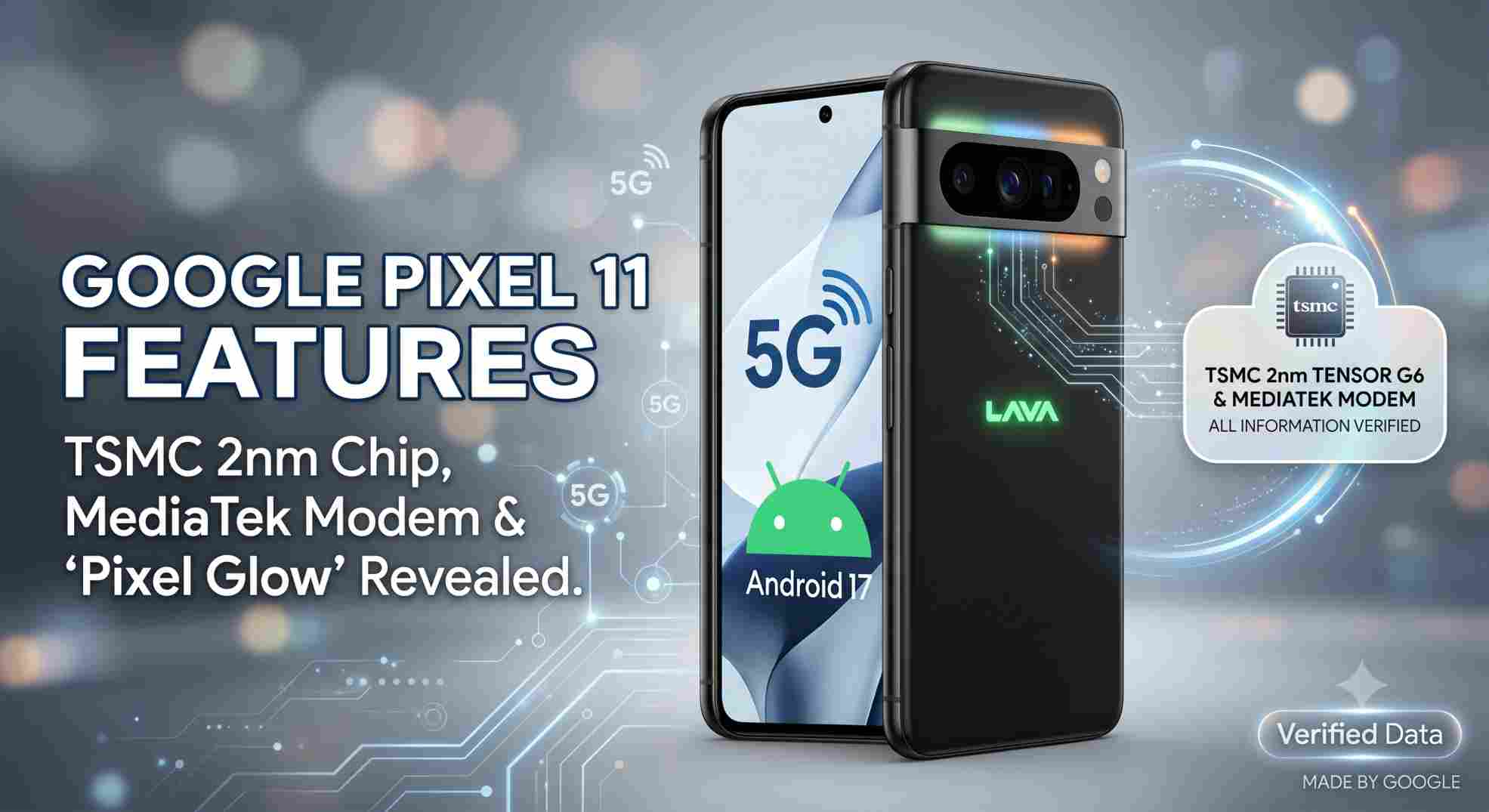
Google Pixel 11 Features: High-Efficiency M16 OLED Panel Evolution
While Google continues with the classic aesthetic design of the rear camera module slot, the structural design has seen some drastic improvements that heavily upgrade the overall Google Pixel 11 Features.
Screen Panel: The baseline model comes equipped with a flat 6.3-inch OLED screen that maintains a regular 1080×2424 pixel resolution display.
M16 Material Upgrade: In terms of the major structural improvement, the inclusion of Samsung’s top-of-the-line M16 OLED screen material that exceeds the capabilities of even the most advanced flagship devices is notable, allowing for improved energy efficiency while achieving peak brightness of 3,100 nits.
Adaptive Refresh Rate: The screen supports adaptive refresh rate from 60Hz to 120Hz and adaptive PWM dimming rate of 240Hz.
Core Performance: TSMC 2nm Tensor G6 and The MediaTek Pivot
This division has made the most significant turning point in Google’s smartphone development history, completely revamping how core Google Pixel 11 Features operate under heavy loads:
Tensor G6 Processor: Google no longer relies on Samsung Foundry. The Google-made Tensor G6 chipset (aka Malibu) has been manufactured using the state-of-the-art 2nm (N2) technology from TSMC. The processor consists of a special 7-core tri-cluster architecture operating under the ARM Lumex CSS scheme with 1x ARM C1-Ultra core with max speed of 4.11GHz, 4x ARM C1-Pro high-performance cores with 3.38GHz, and 2x ARM C1-Pro efficiency cores with 2.65GHz. Thus, there is no overheating problem with the current custom system architecture.
MediaTek 5G Modem: In order to avoid past dropped calls and excessive power consumption, Google does not use any Exynos-based modems anymore. The phone includes the best-performing MediaTek M90 (MT6986D) 5G modem that provides maximum-quality network reception.
RAM Combinations: As for the hardware materials available globally, the regular RAM+storage combo uses 12GB of fast LPDDR5X RAM and UFS 4.0 storage variants.
Upgraded Optics: Advanced Google Pixel 11 Features and “Chemosh” Sensor Blueprint
While Pixel phones have long been synonymous with computational photography, the following are some significant physical changes for this year’s Google Pixel 11 Features lens setup:
Main Camera: This uses an all-new custom-made “Chemosh” sensor with 50MP capability to capture multi-layered imaging in low light situations.
Secondary Module: The camera bar includes a 13MP ultrawide module, alongside a 10.8MP telephoto lens that provides 5X optical zoom capabilities.
Selfie Sensor: This is a 10.5MP punch-hole front camera used for facial recognition and logging videos.
Hardware Twist: The “Pixel Glow” Interface
Google has taken the decision to eliminate the back body temperature sensor module from their past generations to clear space for something way more useful in the official Google Pixel 11 Features list.
Pixel Glow Module: As mentioned above, the empty sensor area has been replaced with a tiny RGB LED notification light system known as Pixel Glow. Placed inside the camera visor, this little module is a highly customizable notification display that glows in harmony with phone calls, applications, and themes.
Battery & Charging Setup: Equipped with a 4,840 mAh (typical 5,000mAh) battery unit, Google supports fast charging up to 30W through both wired and wireless means.
Verified Technical Specifications
| Feature | Official Specification Details |
| Processor | Google Tensor G6 (TSMC 2nm N2 Manufacturing Process) |
| CPU Architecture | 7-Core Tri-Cluster (1x 4.11GHz + 4x 3.38GHz + 2x 2.65GHz) |
| Graphics Processing | PowerVR C-Series CXTP-48-1536 GPU |
| Co-Processors | Titan M3 Security Hub | Custom Dual-TPU “Santafe” AI Engine |
| Display Panel | 6.3-inch M16 OLED Panel, 120Hz, 3,100 Nits Peak Brightness |
| Primary Rear Camera | 50MP “Chemosh” Main + 13MP Ultra-wide + 10.8MP 5x Telephoto |
| Modem Integration | MediaTek M90 5G Cellular Processing Core |
| Battery & Power | 4,840 mAh Battery, 30W Wired Fast Charging, Qi2 Wireless Support |
| Operating System | Android 17 Out-Of-The-Box (7 Years Full Upgrade Cycles) |
| Unique Add-On | Pixel Glow RGB Visual Notification Array (Visor Mounted) |
Expected Market Price and Launch Timeline in India
The Google hardware launching ceremony is expected to take place in August 2026. In view of the worldwide upsurge in the cost of memories and premium TSMC fabrication of its processors, the starting price of the base model of Google Pixel 11 is estimated at $799 worldwide (approximately ₹79,999 in India).
Is it worth the wait?
With the shift to 2nm process technology by TSMC and incorporation of a high-end MediaTek cellular modem, Google has overcome issues such as thermal throttling and reception problems which existed in previous models. If you desire a highly stable, premium, and sleek Android smartphone with advanced Google Pixel 11 features, then this one is worth buying.
Conclusion: Final Take on the New Google Pixel 11 Features
In conclusion, the Google Pixel 11 series is arguably the game-changing milestone that is marking Google’s journey in its ecosystem. With its deliberate effort to rectify years’ worth of consumer frustrations regarding excessive heat on the processors, and unstable cellular modems, Google seems to be shifting gears and turning the Pixel series from being a predominantly software-driven camera smartphone into a high-end flagships series.
This will be made possible with its choice to incorporate advanced features like the new 2nm fabrication node from Taiwan Semiconductor Manufacturing Company (TSMC), and the super-efficient MediaTek M90 5G cellular modems. Combining this solid hardware base with the upcoming Android 17 operating system, and the inventive “Pixel Glow” notifications interface makes the Google Pixel 11 Features an absolute must-watch flagship phone of the year.
My Opinion: A Tech Expert’s Critical Take On Pixel 11 Leaks
As a technical reviewer, I am completely focused on the changes made in terms of Google’s platform development. By shifting towards TSMC’s N2 node and adopting a dual-TPU design, Google is showing its commitment to developing unique AI processors and solving the efficiency problems. Replacing the Exynos modem with MediaTek’s M90 architecture means one big relief for consumers who have been experiencing dropped calls frequently on their daily commute.
On the other hand, it is important to point out some negatives regarding the graphic departments. The use of modified PowerVR C-Series graphics architecture, which relies on outdated architecture designs, is definitely a money-saving strategy. However, consumers interested in playing games with high refresh rates may find that the current graphics framework is lagging behind the best graphics processors created by Qualcomm.
Frequently Asked Questions (FAQs)
Q1. What exactly is the “Pixel Glow” tech included in the Google Pixel 11 Features?
Ans. Pixel Glow is a hardware replacement for the older body temperature sensor. It features an embedded multi-color RGB LED strip inside the camera bar visor that blinks, flashes, or pulses to serve as a visual notification light system, mapping color hues directly to your active UI color choices.
Q2. Is the Tensor G6 inside the Google Pixel 11 built by TSMC?
Ans. Yes, the Google Tensor G6 chipset transitions away from Samsung Foundry plants entirely. It is mass-produced on TSMC’s advanced 2nm process layer, ensuring vastly superior performance stability, lower processing temperatures, and minimal battery drainage.
Q3. Does the Google Pixel 11 configuration support magnetic wireless charging accessories?
Ans. Yes, technical data documents verify that the Google Pixel 11 platform natively integrates the Qi2 wireless charging standard, enabling seamless compatibility with magnetic alignments, wireless battery packs, and charging stands.
Read Also: Apple iPhone 18 Pro Leaks Specifications and Features